

Dear Parent / Guardian
Your child has had a broken bone which had to be realigned to a good position and be fixed with wires to maintain the position.
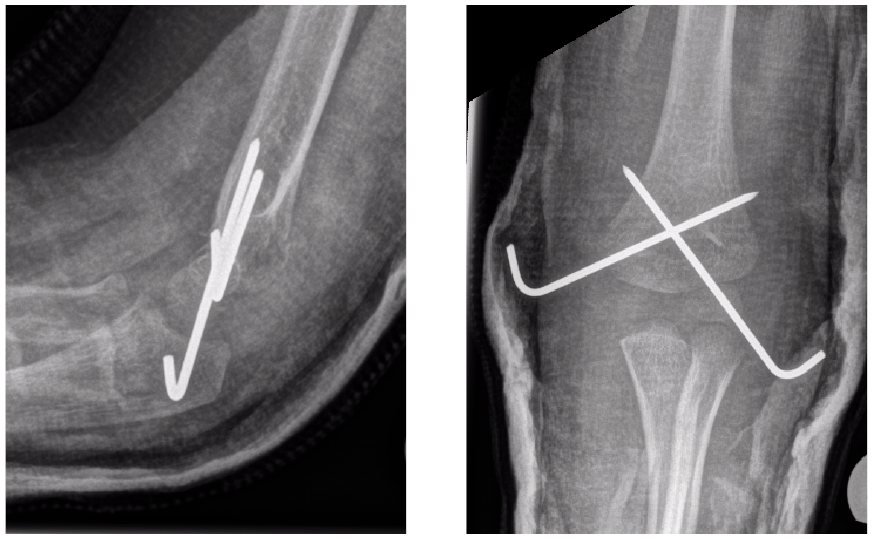
The wires usually stick out of the skin so that they can be easily removed, once the bone has healed. They are covered with padding and a plaster cast and your child will not be able to see or feel them.
Removal of the wires in clinic
The wires are normally removed after about 4 weeks in the clinic because it is relatively easy, not too uncomfortable, safe and quick.
It is important that your child understands what should happen.
Before you come to the clinic, you may wish to give your child some Paracetamol (Calpol) in preparation for the procedure. Please read the instructions on the bottle before giving your child Paracetamol.
An x-ray may be needed to confirm the fracture has healed enough for the wires to be removed.
The plaster cast will then be removed in the Plaster room. This does not hurt but the noise and vibration of the plaster saw can be alarming for young children. Once the cast and dressing have been removed, the wires can be seen sticking out of the skin. Please reassure your child that this is normal.
If your child is older than 5 years old and you wish, Entonox (gas and air) may be used for pain relief. The plaster technician will explain to your child how to use this and how it works. The sites around the wires are cleaned, before they are removed using special pliers. This procedure is quick and may feel strange but is not usually too uncomfortable.
The small wounds will bleed a little bit and dressings are placed over these. Depending on the fracture, a new plaster cast may be applied for a further few weeks.
Removal of the wires in theatre
Sometimes, the wires are not sticking out of the skin. In this case, they will be taken out in theatre under general anaesthetic.
Your child will be seen in clinic beforehand and will have an x-ray to confirm the fracture has healed enough for the wires to be removed. The doctor will explain this in details to you and your child.
Before you leave the clinic, we will confirm the date, time and location of the procedure and a consent form will be signed.
Your child will not be able to eat or drink for some time before they come into hospital and details of this will be discussed before you leave the clinic.
On the day of the procedure, you will meet the anaesthetist who will explain all the risk of a general anaesthetic. If the number of poorly children requiring an urgent operation is high, we may have to cancel the procedure and reschedule it for another day.
After the wires have been taken out, your child will go back to the ward. They will usually have another plaster cast, a splint or a bandage put on to support the limb for a few more weeks. Your child will be able to go home the same day.
Your child will be given an outpatient appointment before going home.
Aftercare
If your child has a soft bandage and / or a simple dressing, they can be removed after 24 hours and your child may get the wounds wet with fresh running water (e.g. showering), but you will need to remove the wet dressing and put on a new clean dry dressing. Once the wound sites have healed over (usually 5 – 7 days), your child may then soak in the bath or swim in the pool as usual.
If after the removal of the wires, your child has required another plaster cast; this will be removed at the next appointment in fracture clinic. After the removal of the cast, the limb will be checked. Your child may have some stiffness, which usually goes away on its own within a few months. Physiotherapy is not necessary but you will be shown exercises to get normal strength and movement back. Your child should not play any contact sports for a further 4 – 6 weeks.
Possible complications
Infection
This is very uncommon but can occur at any time after the wires have been inserted. Signs of infection include increased pain, increased temperature and / or foul smell from the cast. If you think your child may have a wire infection, please call the Paediatric Orthopaedic Clinic Nurses Specialists or the Plaster room (see below), or go to Children’s Emergency department if after hours or over the weekend.
K-wires migration
Occasionally, wires can migrate (move) below the skin surface. If this happens, wire removal will be more difficult and an anaesthetic may be required. If this occurs, the wire removal will take place in theatre and the procedure will be done as a day case surgery, not in the Outpatient department.
Loss of position
If the surgical correction slips and the ends of the bone go out of position, it could mean more surgery is needed.
Overgranulation
This is an excess of healing tissue around the pin(s) site(s). This is managed with special dressings and usually heals uneventfully in a few weeks but may require a few clinics attendance.
Useful telephone numbers
If you have any questions or concerns, please contact:
Children’s Orthopaedic Team: 0113 392 8570
Clinical Nurse Specialists:
Charlotte Tasker
Victoria Wilkinson
Elaine Hubbard
Senior Clinical Support Worker:
Saima Rafique
Plaster Room: 0113 392 5717